Why your discount plan might not be cheaper
Guaranteed vs conditional discounts, the DMO/VDO reference price, and why yearly cost for your usage beats a big percentage off.
Nov 10, 2026

Header photo already used on the live Guides post. From Unsplash (free licence): https://images.unsplash.com/photo-1607863680198-23d4b2565df0 — photographer credit is on that Unsplash photo page.
A big percentage off your bill sounds like a win. Sometimes it is. Sometimes the discount is attached to higher base rates, only applies if you jump through hoops, or is measured against a reference household that isn't you.
Here's how to read discount plans without getting caught out.
Guaranteed discount vs conditional discount
Not all discounts are equal.
A guaranteed discount is built into the price you pay. You get it whether you pay early, set up direct debit, or pay by the due date.
A conditional discount only applies if you meet the retailer's rules. Common conditions include:
paying on time
paying by direct debit
receiving bills by email
Miss a condition and the discount can disappear for that bill — or longer, depending on the plan. When you compare offers, check the price with and without the conditions. If a plan only looks cheap when everything goes perfectly, treat that as a risk, not a guarantee.
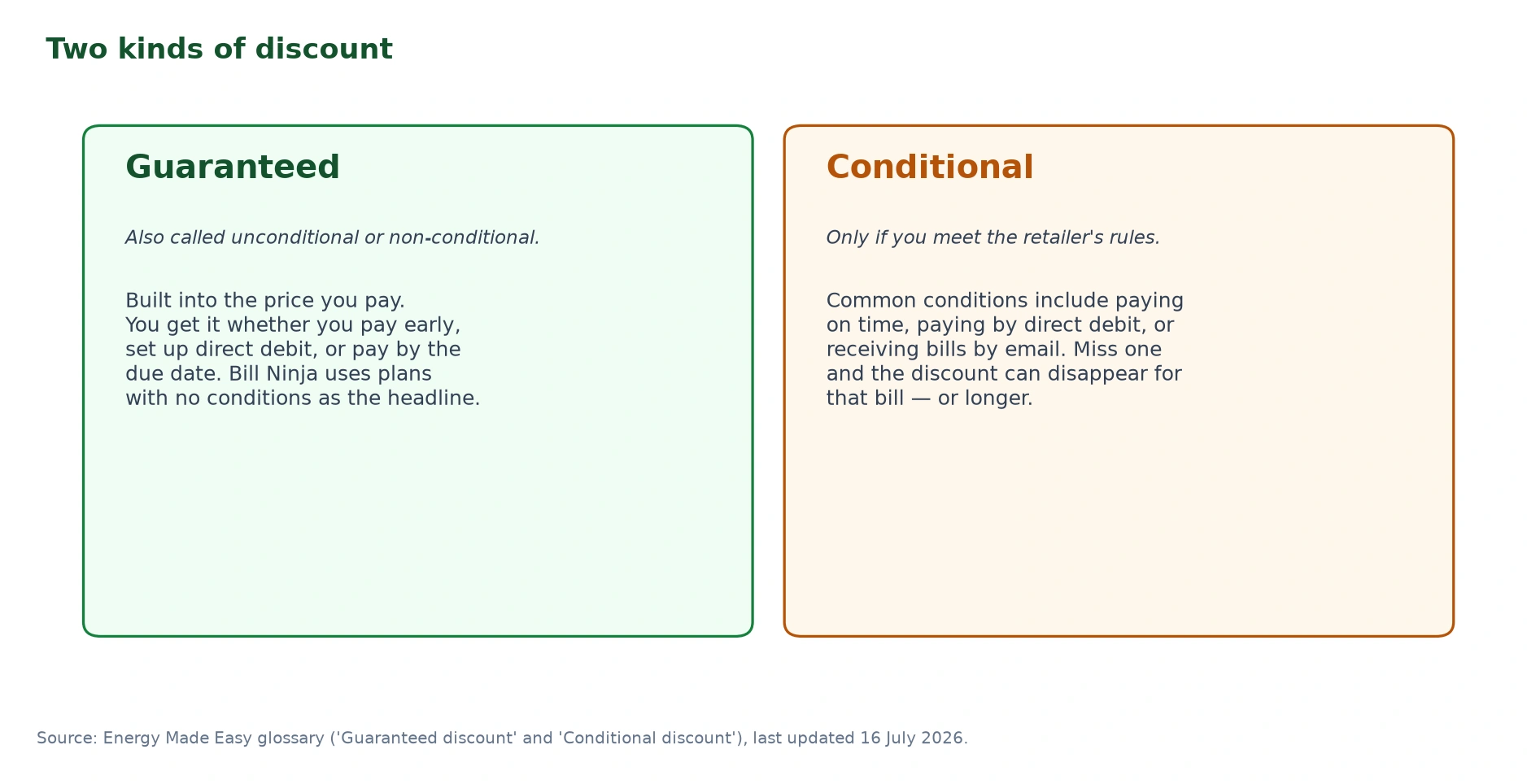
Source: Energy Made Easy glossary ("Guaranteed discount" and "Conditional discount"), last updated 16 July 2026.
The reference price is a yardstick, not your bill
In New South Wales, south-east Queensland and South Australia, the Australian Energy Regulator sets a Default Market Offer (DMO) each year. In Victoria, the Essential Services Commission sets a Victorian Default Offer (VDO).
These default offers do two jobs:
They cap what retailers can charge customers on a standing offer (the default plan you land on if you never choose one).
They act as a reference price so market offers can be advertised as a percentage above or below that benchmark.
Retailers in those regions must show how their plan compares with the reference price for a typical household on that network. That percentage is useful for a quick scan. It is not a promise of what you will pay. The reference assumes a benchmark amount of yearly usage for each network area. If you use more or less than that — or if you have solar, controlled load, or a time-of-use meter — your result can look very different.
A plan advertised as "20% less than the reference price" can still cost you more than a plainer offer, once your real usage is applied.
Compare on estimated yearly cost for your usage
The cleanest way to judge a plan is the estimated annual cost based on your consumption, not the headline discount.
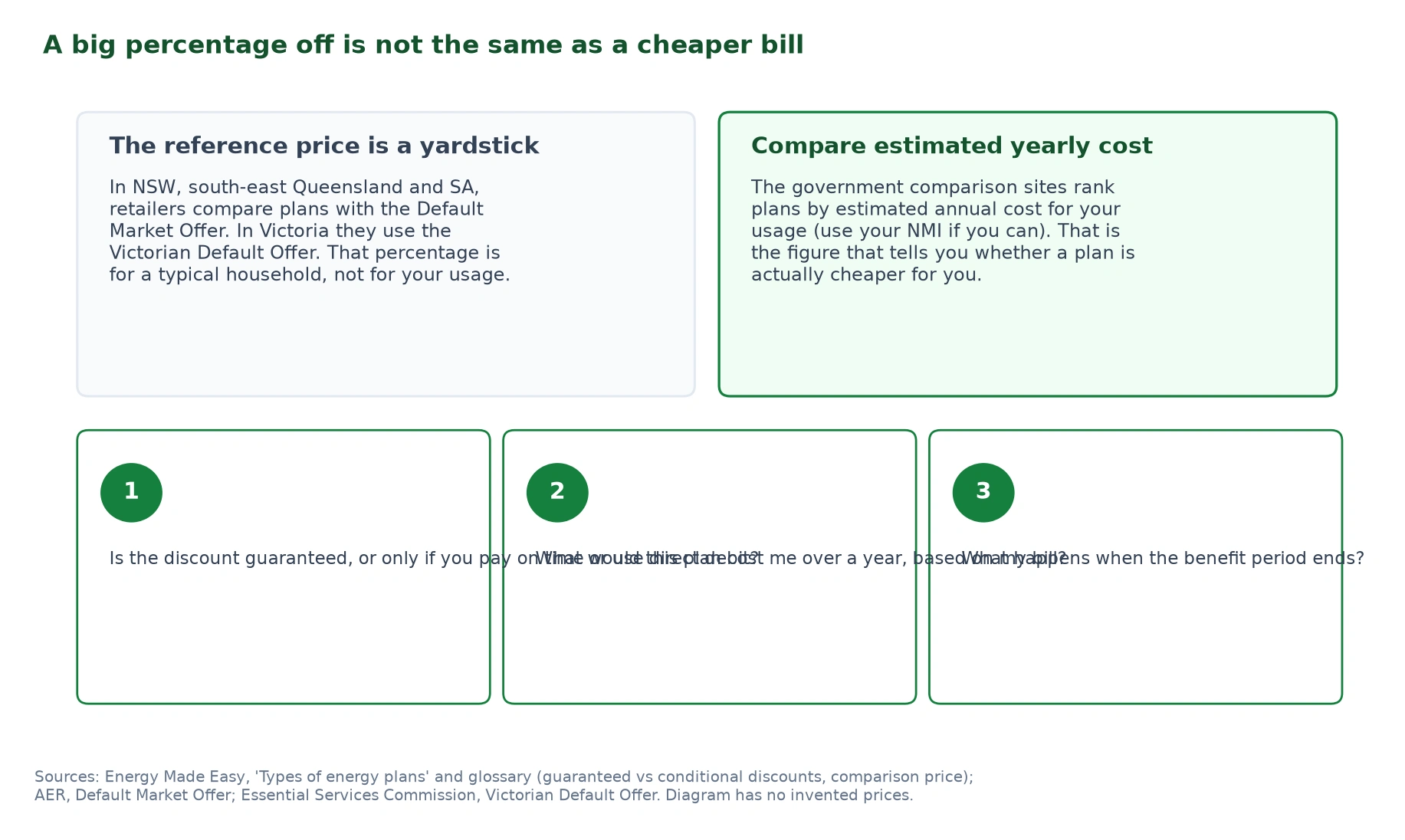
Sources: Energy Made Easy (types of plans and comparison price); AER Default Market Offer; Essential Services Commission Victorian Default Offer. No invented prices.
The free government comparison sites do exactly that:
Energy Made Easy for NSW, QLD, SA, TAS and the ACT
Victorian Energy Compare for Victoria
Enter your NMI (or usage from a recent bill) and the sites rank plans by estimated yearly cost for your profile. That ranking already folds in supply charges, usage rates, and the discounts that apply under each plan's rules.
When you read the results, check:
whether a discount is guaranteed or conditional
any exit fees or benefit periods that end after a set time
feed-in rates if you have solar
whether the plan matches your meter type (flat rate, time-of-use, controlled load)
"Better offer" messages on your bill
Retailers are also required to tell you, from time to time, if they have a cheaper plan for your usage than the one you're on. That message is helpful — but it only covers plans from your current retailer.
It won't show you whether another retailer has a better deal. A full comparison on the government sites (or an independent check) still matters.
A simple habit that beats chasing discounts
Instead of hunting for the biggest percentage, ask:
What would this plan cost me over a year, based on my last bill?
Do I have to do anything special to keep the discount?
What happens when the benefit period ends?
If you can answer those three questions, you're already ahead of most of the marketing.
We can run the comparison for you
Bill Ninja checks your bill on the same free government sites anyone can use, then emails you a plain-English report — usually within about 24 hours. We're independent: no upfront fee, no retailer commissions, and you tip only what's fair if we find savings.