Time-of-use vs single-rate electricity plans: which is cheaper for you?
Time-of-use plans charge more in the evening peak and less during the day. Here's how they work, and how to tell if one suits you.
Nov 10, 2026

Some electricity plans charge the same usage rate around the clock. Others charge more in the evening and less in the middle of the day. The second kind is called a time-of-use plan, and it can be cheaper or dearer depending on when you actually use power — not on how the plan is advertised.
If you have a smart meter, you may already be able to choose either type. In some networks, solar homes are limited in which tariff they can be on. The only reliable way to decide is to look at your own usage by time of day.
Single-rate plans: one price all day
Energy Made Easy also calls this a flat rate, standard rate or anytime rate. You pay the same amount for each kilowatt hour from the grid, whatever time you use it.
That makes bills easier to follow, and it can suit households whose use is bunched in the evening — cooking, heating or cooling, and screens after work — when a time-of-use peak rate would be at its highest.
You still pay a daily supply charge as well. A cheap usage rate with a high supply charge can cost a low user more than a plainer plan.
Time-of-use plans: peak, off-peak and sometimes a solar soak
On a time-of-use plan, the day is split into windows. Energy Made Easy describes the usual building blocks:
Peak — when electricity costs the most, often in the late afternoon and evening
Off-peak — when it costs less, often overnight
Shoulder — a middle rate, on some plans, between peak and off-peak
Some plans also have a cheap window in the middle of the day, sometimes called a solar soak or solar sponge, to encourage use when rooftop solar is flooding the grid.
The exact hours are not the same everywhere. They can differ by state, network, weekday and weekend, and even by season.
Victoria's default time-of-use standing offer, from 1 July 2026, is a clear official example. The Essential Services Commission sets the same windows every day:
solar soak: 11 am to 4 pm
peak: 4 pm to 9 pm
off-peak: 9 pm to 11 am
The usage rates in that default offer show why the windows matter. On the CitiPower network, for example, the 2026–27 VDO charges 16.59 cents per kWh in the solar soak, 21.17 cents off-peak, and 38.31 cents in the peak — more than twice the midday rate. Other Victorian networks follow the same hours with their own rates.
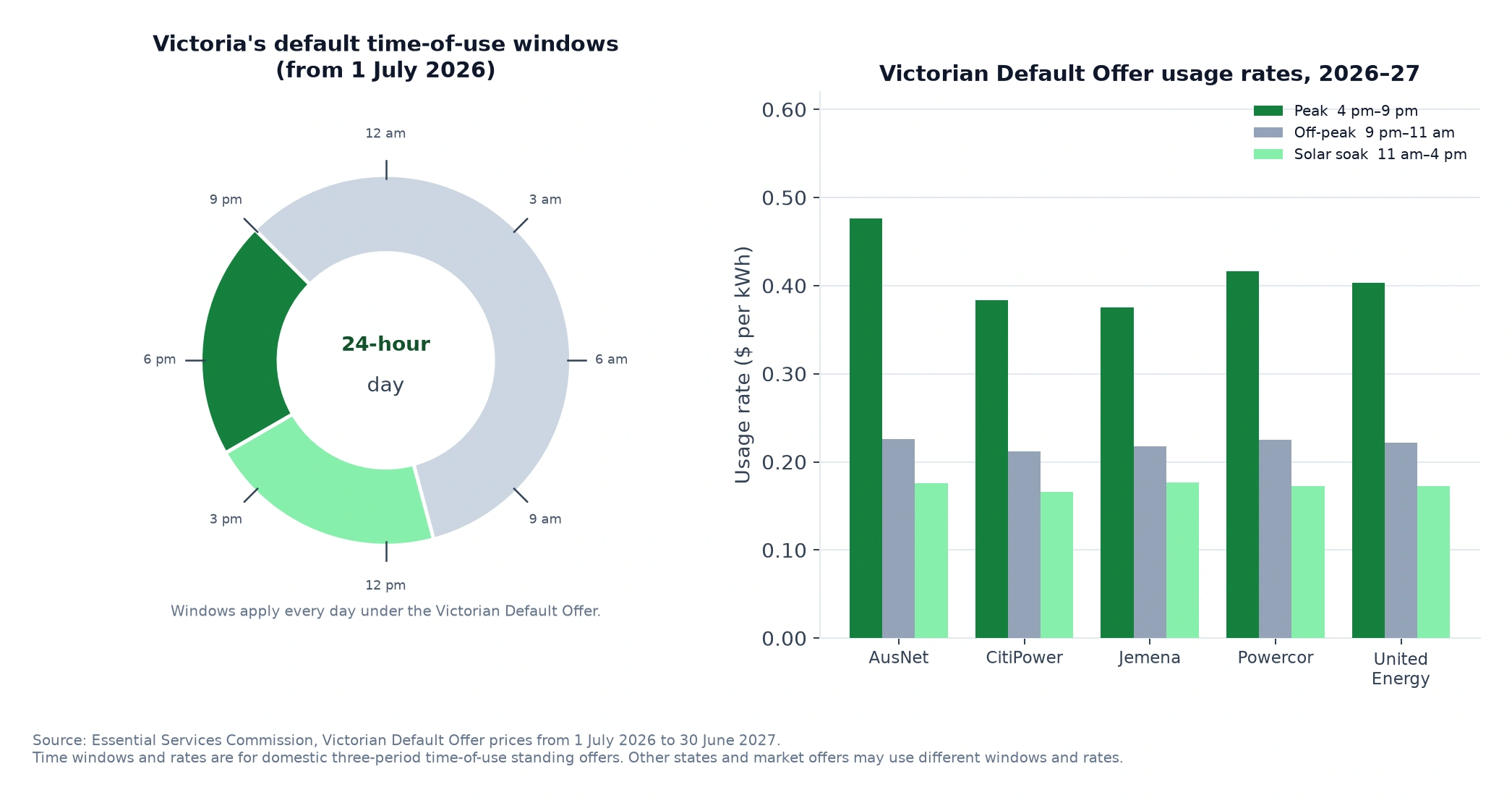
Source: Essential Services Commission, Victorian Default Offer prices from 1 July 2026 to 30 June 2027, domestic three-period time-of-use standing offers. Market offers, and plans outside Victoria, may use different windows and rates.
Which one is cheaper?
A time-of-use plan rewards you if you can shift flexible use — a dishwasher, washing machine, dryer, pool pump, or an EV charger — into the cheaper window. It can also suit solar households that still import from the grid, because the expensive period is often after sunset.
It can cost more if most of your use is already in the evening peak and you cannot move it. In that case a single-rate plan, or a time-of-use plan with a milder peak, may work out cheaper.
Two extra tariff types sometimes sit alongside either option:
Controlled load (also called off-peak hot water, or Tariff 31 or 33 in Queensland, and Tariff 61 or 63 in Tasmania) is a separate, usually cheaper rate for a specific appliance on its own circuit, often overnight.
Demand charges, more common for small businesses, add a charge based on your highest draw from the grid at a point in time, not only on how many kilowatt hours you use.
energy.gov.au also notes that some networks do not allow solar customers to stay on a flat tariff. If you have just installed panels, check which tariff you were moved to, then compare.
How to decide with your own data
Look at a recent bill, or your smart-meter / retailer app, and see how much you use in each window — not just the total kilowatt hours.
Enter your NMI on Energy Made Easy or Victorian Energy Compare so the estimate can use your actual pattern.
Rank plans by estimated yearly cost, not by the cheapest off-peak or solar-soak rate alone.
Check the daily supply charge, any controlled-load rate, and whether a discount is guaranteed or conditional.
If the government site can see your interval data, it will do that maths more fairly than a rule of thumb.
We can check it for you
Bill Ninja compares your bill on those same government sites and emails a plain-English report — usually within about 24 hours — with no-conditions plans as the headline. We cover New South Wales, Queensland, South Australia, Tasmania, the ACT and Victoria. No upfront fee, no card, no retailer commissions. If we find a saving and you're happy, tip what feels fair.