The Default Market Offer and Victorian Default Offer: why the default plan may cost you more
The DMO and VDO cap standing offers from 1 July each year. Here's what they mean, and why comparing market plans still matters.
Nov 10, 2026
If you have been with the same electricity retailer for years, or you never chose a plan when you moved in, there is a good chance you are on a standing offer — sometimes called a standard retail plan or the default plan.
That plan is not a reward for loyalty. It is a safety net. And the government's own comparison site says standing-offer prices are generally higher than market retail plans.
What the Default Market Offer is
The Default Market Offer, or DMO, is set by the Australian Energy Regulator. It is the maximum price retailers can charge residential and small business customers on a standing offer for electricity in New South Wales, south-east Queensland and South Australia.
It does two jobs:
It caps what you can be charged if you are on a standing offer in those regions.
It acts as a comparison price, so retailers must show how a market offer sits above or below that benchmark for a typical household on that network.
The DMO is locked in for 12 months from 1 July each year. The current determination, known as DMO 8, applies from 1 July 2026 to 30 June 2027.
The published annual figures are comparison prices for a set amount of yearly usage in each network. They are not a forecast of your bill. If you use more or less than the benchmark — or you have solar, a time-of-use meter or controlled load — your result will differ.
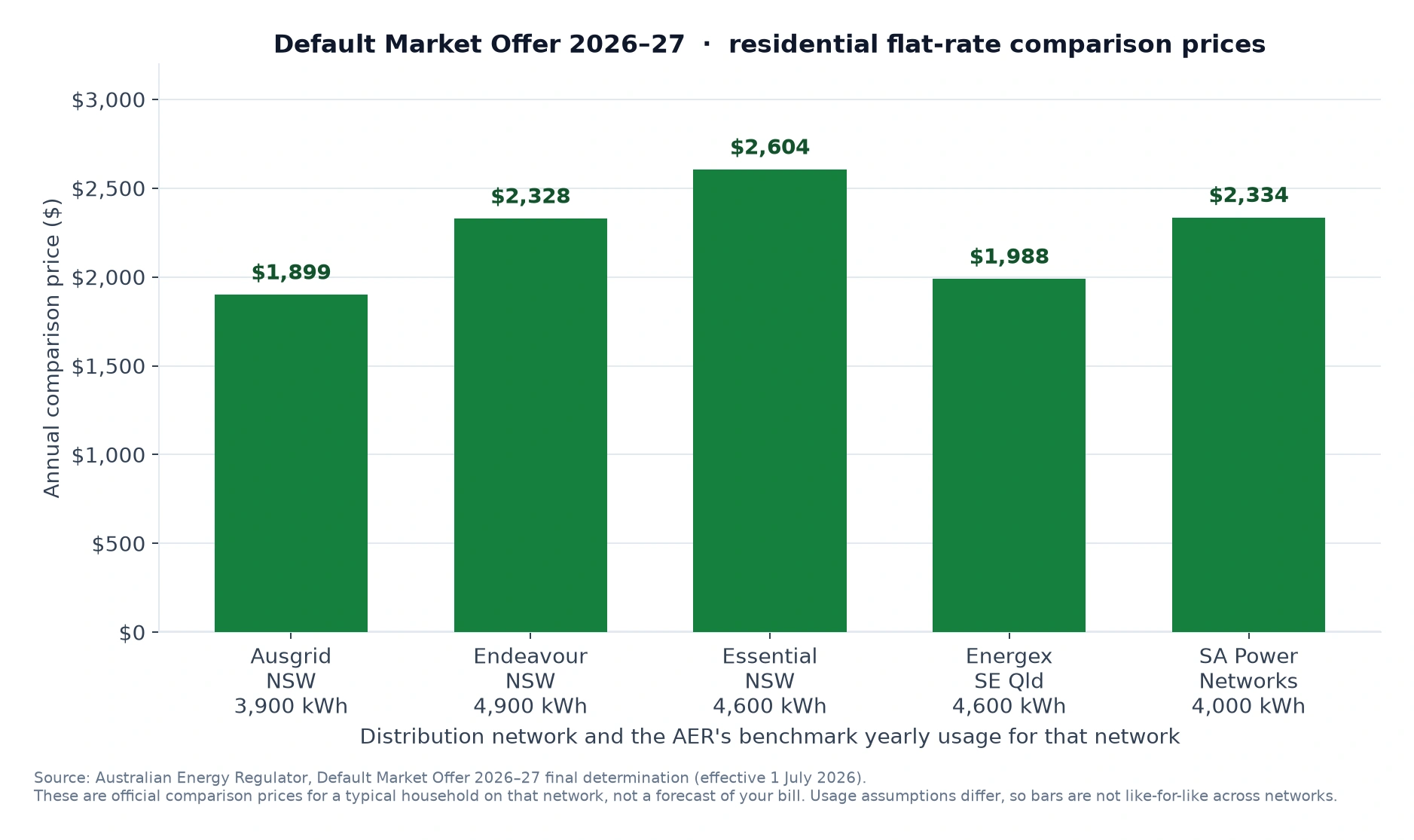
Source: Australian Energy Regulator, Default Market Offer 2026–27 final determination, effective 1 July 2026. Usage assumptions differ by network, so the bars are not like-for-like across regions. These are official comparison prices, not a prediction of what you will pay.
What the Victorian Default Offer is
Victoria has its own version, the Victorian Default Offer, or VDO, set by the Essential Services Commission. It is a reasonably priced default option for customers who cannot or do not want to shop around, a price cap for many embedded-network customers who cannot choose their retailer, and a reference price for comparing market deals.
The current VDO applies from 1 July 2026 to 30 June 2027. The Commission says average annual bills for households on a flat tariff, assuming 4,000 kWh a year, are 5 per cent lower than in 2025–26 — about $84 a year on average. The change varies by network: from $50 less in United Energy to $160 less in AusNet.
In its 25 May 2026 announcement, the Commission also said about 17 per cent of Victorian households (512,000) were on the VDO. A default plan is common, not unusual.
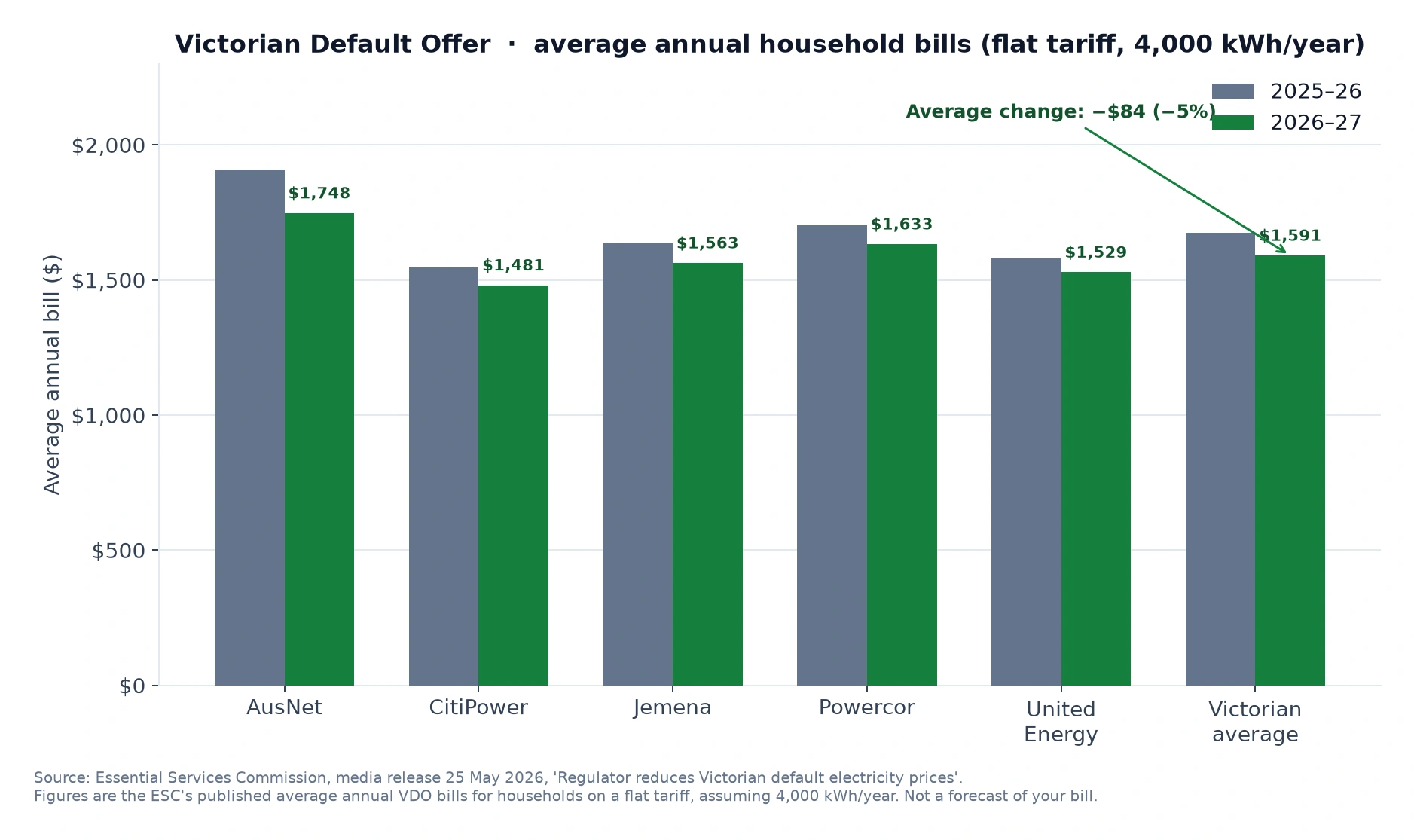
Source: Essential Services Commission media release, 25 May 2026, "Regulator reduces Victorian default electricity prices". Figures assume 4,000 kWh a year on a flat tariff.
Tasmania and the ACT are not covered by the DMO or the VDO. You can still compare plans on Energy Made Easy. In regional Queensland, energy.gov.au notes that plans are regulated and customers have less (or no) choice of retailer.
Why staying on the default can cost you
Energy Made Easy puts it plainly: on a standard retail plan, prices are often set by the government, "are generally higher than market retail plans", and cannot change more than once every six months. You also do not get the discounts that can come with market offers.
You might be on a standing offer if you have been at the same address for several years, a market plan has expired, or you never took one up.
The cap protects you from unlimited standing-offer prices. It does not mean you are on the cheapest plan available. Market offers are set by retailers and can be lower — or, depending on your usage, not. The only way to know is to compare estimated yearly cost for your household, not the headline percentage above or below the reference price.
A "better offer" message on your bill is useful, but it only covers plans from your current retailer. It will not tell you whether another retailer is cheaper.
What to do next
Check your bill for the plan name, and whether it is described as a standing offer, standard retail plan or default offer.
Compare plans on Energy Made Easy or Victorian Energy Compare, using your NMI if you can.
Rank by estimated yearly cost for your usage, and check whether any discount is guaranteed or only applies if you pay on time or use direct debit.
If you would rather not do that yourself, we can run the same official comparison for you.
We can check it for you
Bill Ninja checks electricity and gas bills for homes and small businesses in New South Wales, Queensland, South Australia, Tasmania, the ACT and Victoria. We use the government's free comparison sites, and we use no-conditions plans as the headline. You'll usually have a plain-English report within about 24 hours. No upfront fee, no card, no retailer commissions. If we find a saving and you're happy, tip what feels fair.