Is it safe to switch energy retailers in Australia?
Switching retailers doesn't cut your power or change the poles and wires. Here's how a switch works, including the 10-day cooling-off period.
Nov 10, 2026
A lot of people stay on an expensive electricity plan for a simple reason: they do not want to risk a blackout, a new meter, or a messy transfer. Those worries are understandable. They are also, in the ordinary case, unfounded.
Switching retailers is a change in who sells you energy and who sends the bill. It is not a change in the wires, pipes or meter that serve your home.
Your power stays on
The Australian Energy Regulator puts it directly: even if you switch retailers, you will still have the same electricity and gas supply to your property. The distributor — the company that owns the poles, wires and pipes — does not change.
Victorian Energy Compare is just as plain: your electricity or gas supply will not be interrupted when you change offers or move to a different retailer. You will still have power in your home. The new retailer uses the existing distribution network and your meter.
If the lights go out, you still call the distributor's faults number on your bill, not the retailer you just left.
You do not need a new meter just to switch
A retailer switch does not mean someone has to replace the meter on the wall. The meter stays where it is, and the new retailer bills you from that same connection (identified by your NMI for electricity, or MIRN for gas).
Smart meters are becoming the standard in Australia, and many homes already have one — especially in Victoria. That is separate from the decision to change retailers. The AER notes that if your retailer later contacts you to arrange a smart meter under the rules, the installation is a metering upgrade, not a condition of switching.
How a switch actually works
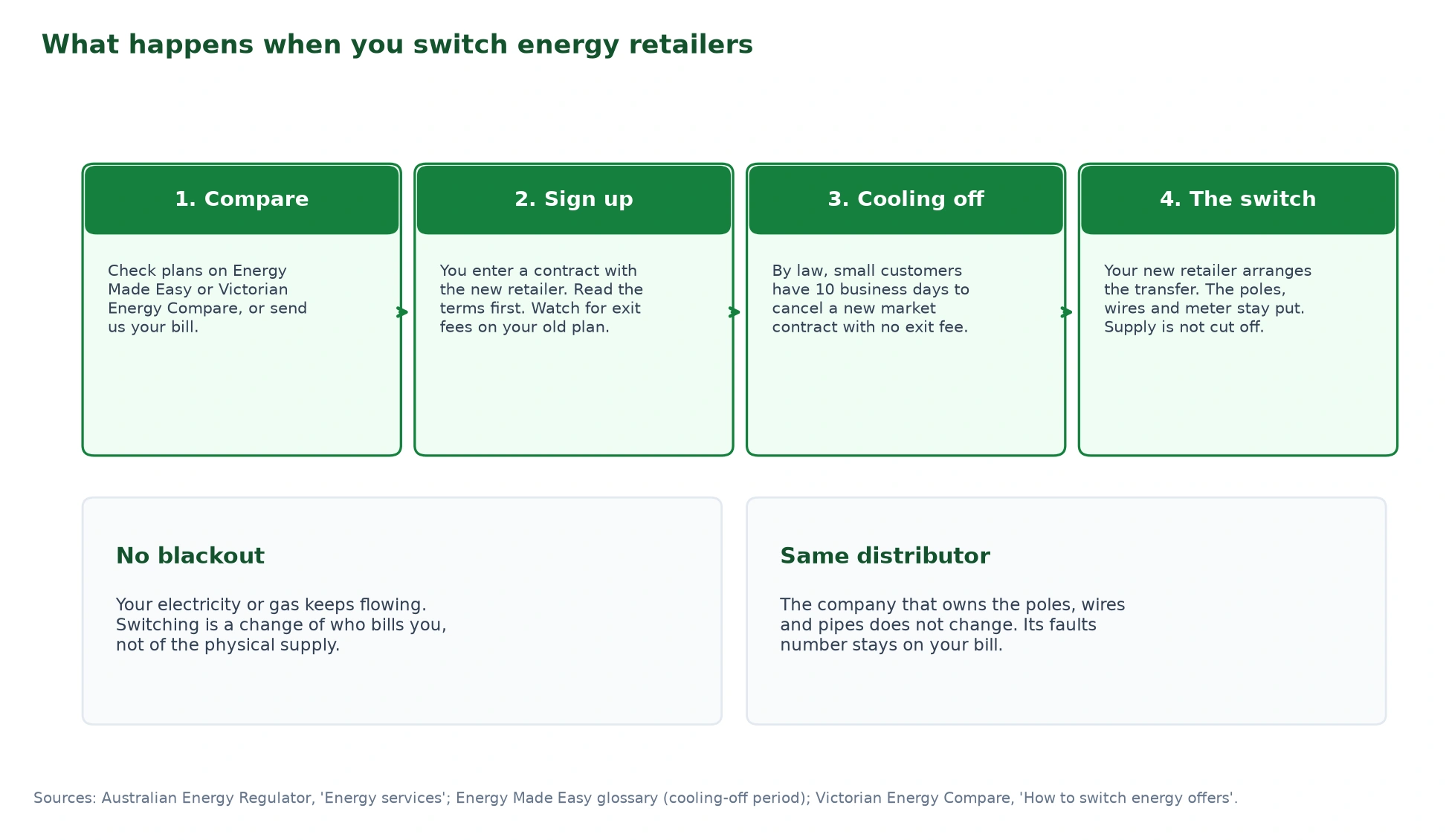
Sources: Australian Energy Regulator, "Energy services"; Energy Made Easy glossary; Victorian Energy Compare, "How to switch energy offers".
In practice, the steps look like this:
Compare plans, ideally with your NMI and a recent bill, on Energy Made Easy (New South Wales, Queensland, South Australia, Tasmania and the ACT) or Victorian Energy Compare (Victoria).
Sign up with the retailer you choose. Read the contract. If you are on a fixed-term plan, check whether leaving early would trigger an exit fee.
Sit tight while the new retailer arranges the transfer, including notifying your current retailer. You should not have to run between the two.
Pay your final bill from the old retailer, and any outstanding amount, when it arrives.
If you rent, the AER suggests speaking with your landlord or housing association, because a tenancy arrangement can sometimes affect whether you can switch. In most ordinary rentals the account holder can still choose the retailer, but it is worth checking.
You have 10 business days to change your mind
By law, small customers who sign up to a new market retail contract have a cooling-off period of 10 business days. Energy Made Easy says you can cancel in that window without paying exit fees. The AER's consumer guidance says the same: if you change your mind, you have 10 business days from signing to cancel without incurring fees.
That protection exists for a reason. You can compare carefully, then still walk away if the contract is not what you expected.
A few things a switch does not fix
Switching will not change a local network outage, and it will not make the distributor someone else. It also will not automatically move a concession or rebate for you in every state — in South Australia, for example, you need to tell ConcessionsSA when you change retailers.
And a cheaper plan is only cheaper if it actually fits your usage. Compare on estimated yearly cost, and check whether a discount depends on paying on time or using direct debit.
If you would like a hand with that comparison, we can do it on the same government sites and send you a plain-English report.
We can check it for you
Bill Ninja checks bills for homes and small businesses in New South Wales, Queensland, South Australia, Tasmania, the ACT and Victoria. We compare plans on the government's free sites, use no-conditions plans as the headline, and usually report back within about 24 hours. No upfront fee, no card, no retailer commissions. You decide whether to switch. If we find a saving and you're happy, tip what feels fair.