Is a higher solar feed-in tariff always better?
Why self-consumption and usage rates usually matter more than a high feed-in tariff, plus how time-of-use plans change the maths for solar homes.
Nov 10, 2026
Header photo already used on the live Guides post. From Unsplash (free licence): https://images.unsplash.com/photo-1655300256335-beef51a914fe — photographer credit is on that Unsplash photo page.
If you have rooftop solar, it's natural to hunt for the highest feed-in tariff. More cents per kilowatt hour exported to the grid sounds like more money in your pocket.
Often, though, the feed-in rate is the wrong number to obsess over. Here's why — and what to look at instead.
What a feed-in tariff actually pays you for
When your panels make more electricity than your home is using, the surplus is exported to the grid. Your retailer credits you for that export at the feed-in rate on your plan.
When the sun isn't covering your needs — typically evenings and cloudy days — you buy electricity from the grid at your usage rate.
Those two rates are almost never equal. In Australia, feed-in tariffs are typically much lower than the rate you pay to import power. The federal energy site puts it plainly: self-consuming your solar usually saves you more than exporting it.
So every kilowatt hour you use straight from your panels avoids buying a more expensive unit from the retailer. Every kilowatt hour you export earns a smaller credit instead.
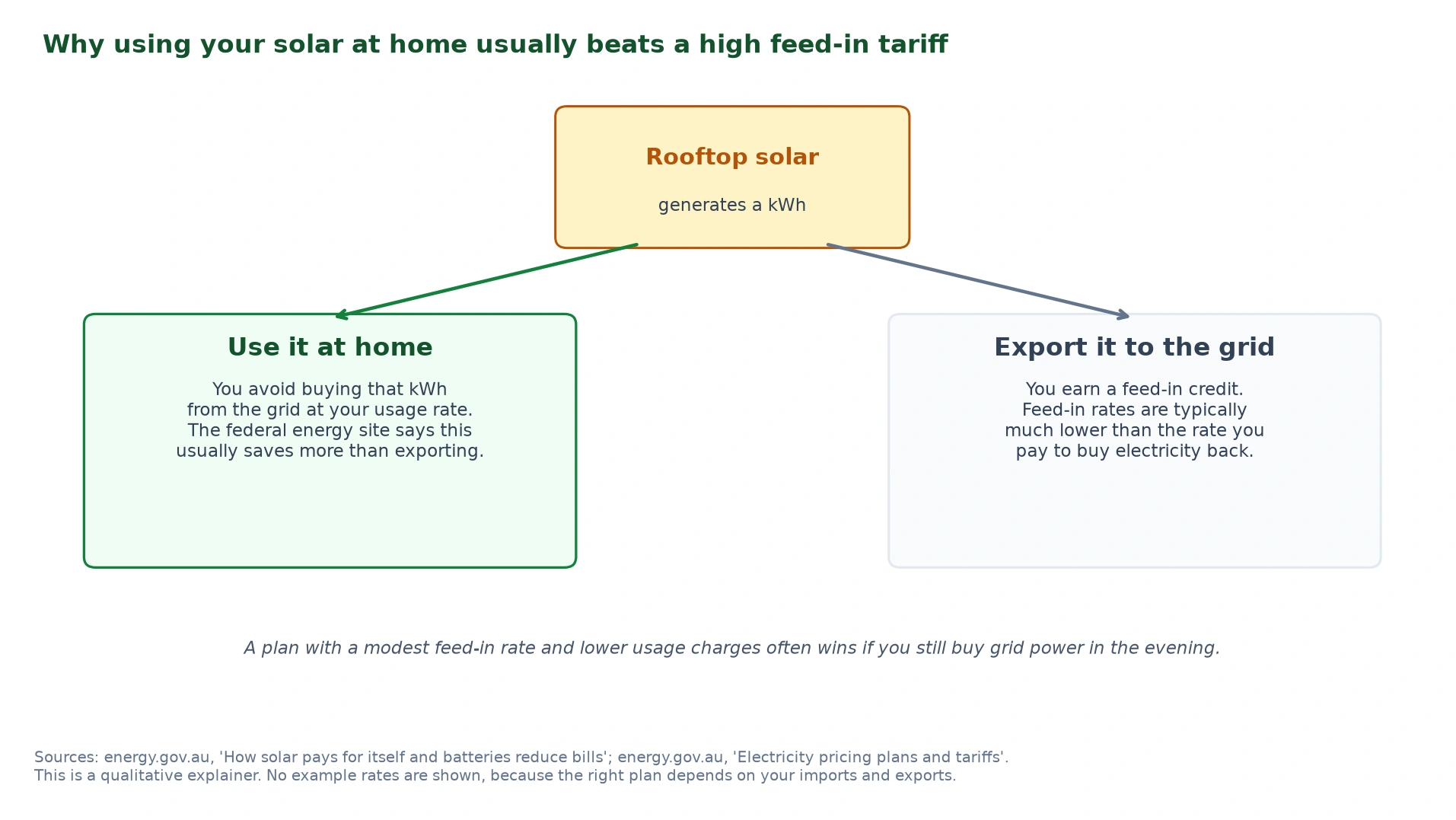
Sources: energy.gov.au, "How solar pays for itself and batteries reduce bills"; energy.gov.au, "Electricity pricing plans and tariffs". Qualitative only — no invented rates.
Why a "high feed-in" plan can still cost more
Retailers price a plan as a package. A generous feed-in rate is sometimes paired with:
a higher daily supply charge
higher usage rates when you buy from the grid
conditional discounts you might miss
limits on how much export is credited each day
If you still import a lot of electricity in the evening — which most households do — those higher usage rates can wipe out the extra feed-in credit.
The right question isn't "who pays the most for my exports?" It's "which plan has the lowest estimated yearly cost for my mix of imports and exports?"
Self-consumption usually beats chasing export credits
Self-consumption means using your solar at home while it's being generated: running the dishwasher, washing machine, pool pump, or hot water when the panels are producing.
Practical ways to lift self-consumption without buying new gear:
Put flexible appliances on a daytime timer
Charge devices and tools while the sun is up
Check whether your hot water can be set to heat in the middle of the day
If you later add a battery, you can store daytime solar for the evening peak — often when grid rates are highest on a time-of-use plan. A battery changes the maths, but the principle stays the same: electricity you don't have to buy is usually worth more than electricity you export.
Time-of-use plans and solar
Many networks now use time-of-use pricing: higher rates in the late afternoon and evening peak, and lower rates in the middle of the day (sometimes called a solar soak or solar sponge window).
For solar homes, that can cut both ways:
Daytime solar you use yourself may only avoid a cheap midday rate
Evening imports can be expensive if you still draw heavily from the grid after sunset
Whether a time-of-use plan beats a flat rate depends on when you import power, not just how much solar you export. Your smart meter data (or a recent bill with time-of-use breakdowns) is the honest way to decide.
Some plans also offer time-varying feed-in rates — lower in the middle of the day, higher in the evening. Those tend to favour households that can export later (often with a battery), not daytime-only exporters.
How to compare solar plans properly
When you check plans on Energy Made Easy or Victorian Energy Compare:
Use your NMI so the site can pull (or you can enter) your real usage and export figures.
Rank by estimated yearly cost, not by feed-in rate alone.
Note the feed-in rate, any daily export caps, and whether the plan matches your meter type.
Check supply charges and usage rates with the same care you'd give the feed-in line.
A plan with a modest feed-in rate and lower usage charges often wins for households that still buy a fair bit of grid power at night.
We can check the whole picture
Bill Ninja compares your bill on the free government sites and emails a plain-English report that weighs usage, supply charges and solar credits together — usually within about 24 hours. Independent, no upfront fee, no retailer commissions. Tip only what's fair if we find savings.