How to read your energy bill
Supply charge, usage rate, kWh, feed-in tariff and NMI — the five figures that actually matter on an Australian electricity or gas bill.
Nov 10, 2026
Header photo already used on the live Guides post. From Unsplash (free licence): https://images.unsplash.com/photo-1772588627342-5ec373e236d8 — photographer credit is on that Unsplash photo page.
Energy bills can look like a wall of fine print. The good news is you only need a handful of figures to work out what you're paying for — and whether a better plan might exist for your home.
Here are the five numbers that matter most, and where to find them.
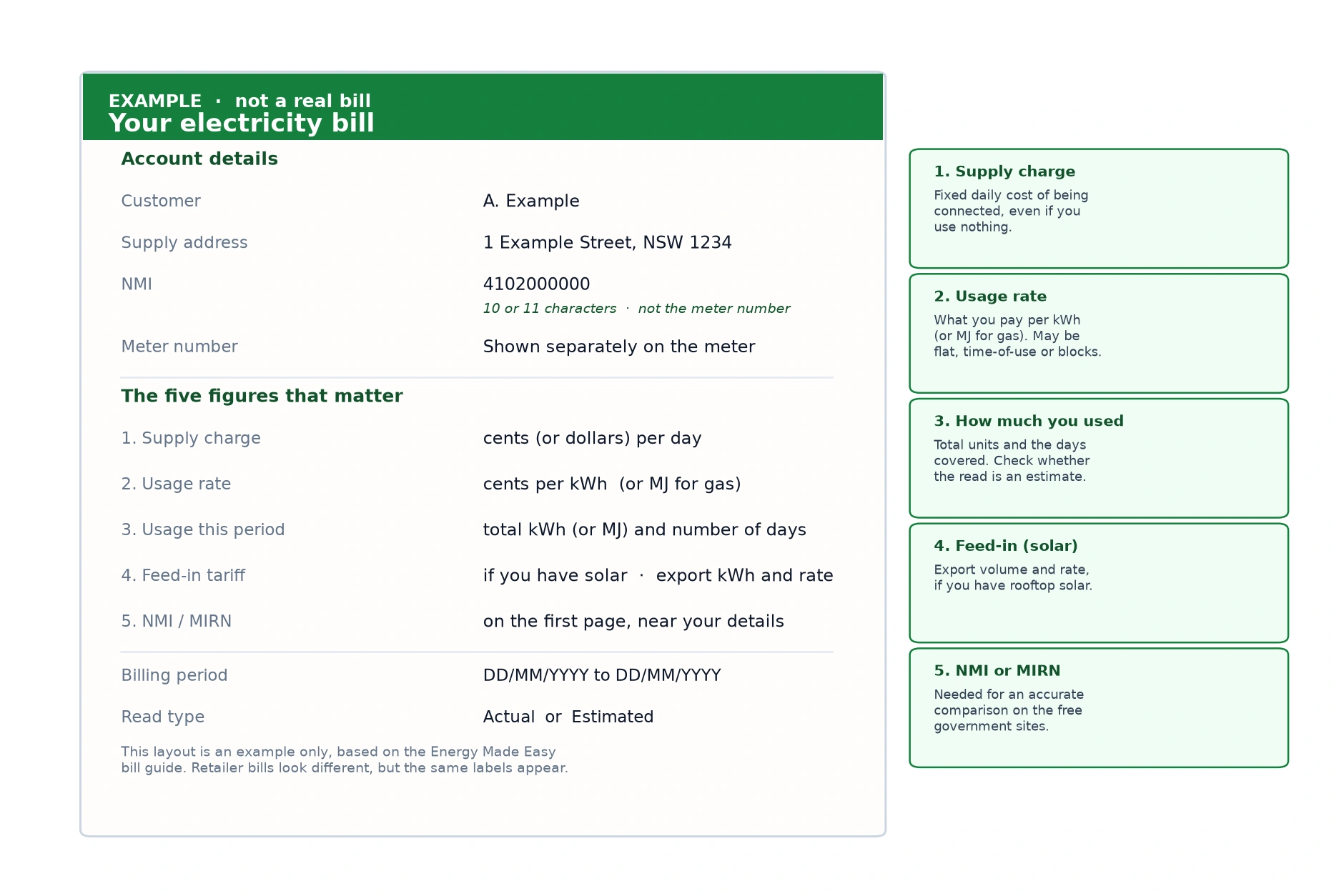
Example only, based on Energy Made Easy's bill guide. This is not a real bill and shows no dollar amounts.
1. Supply charge (also called the daily supply or service charge)
This is the fixed cost of being connected to the network. You pay it every day of the billing period, even if you use no electricity or gas at all.
On your bill it usually appears as cents (or dollars) per day, then as a total for the period. Multiply the daily rate by the number of days on the bill and you should land on that total.
A high supply charge can quietly wipe out a plan that looks cheap on usage alone — especially if you're a low user.
2. Usage rate (cents per kilowatt hour)
This is what you pay for each unit of electricity you use. Electricity is measured in kilowatt hours (kWh). Gas is measured in megajoules (MJ).
Some plans have a single flat rate. Others split the day into peak, shoulder and off-peak windows (a time-of-use plan), or into blocks where the rate changes after you use a certain amount.
When you compare plans, match the rate structure to how you actually use energy. A cheap off-peak rate only helps if you can shift some of your use into that window.
3. How much you've used (kWh or MJ)
Look for the total usage for the billing period, and ideally the average per day. Check the number of days the bill covers too — a longer period can make a bill look bigger even when your daily use hasn't changed.
If your bill says the reading is an estimate, treat the figure carefully. An actual meter read is more reliable for comparing plans.
Your usage pattern is the biggest reason two neighbours on the same street can get very different "best plan" results.
4. Feed-in tariff (if you have solar)
If you have rooftop solar, your bill should show how much electricity you exported to the grid and the feed-in rate you were credited for it (usually in cents per kWh).
A higher feed-in rate looks attractive, but it is only one side of the story. The rate you pay when you buy electricity from the grid usually matters more, because most households still import power in the evening.
If you don't have solar, you can skip this number.
5. Your NMI (or MIRN for gas)
Your National Metering Identifier (NMI) is the unique code for the electricity connection at your address. It is usually 10 or 11 characters and often sits near your supply address or customer details on the first page of the bill.
It is not the same as the number printed on the physical meter on your wall.
For gas, the equivalent identifier is often called a MIRN (Meter Identification Reference Number) or similar, depending on your retailer and state.
You'll need this identifier for an accurate comparison on the free government sites — Energy Made Easy (for NSW, QLD, SA, TAS and the ACT) or Victorian Energy Compare (for Victoria). With a valid NMI, those sites can often pull your meter data and price plans against your real usage, not a generic household average.
A quick way to use these five numbers
Once you have them:
Note your supply charge and usage rates (and any discounts that apply).
Note your total kWh (or MJ) and the days covered.
If you have solar, note the feed-in rate and how much you exported.
Find your NMI (or MIRN).
Plug them into Energy Made Easy or Victorian Energy Compare — or send the bill to someone who will do that for you.
That last step turns five scattered numbers into a clear answer: is there a cheaper plan for your usage?
We can check it for you
Bill Ninja is an independent, tip-based energy bill checker. You send us your electricity or gas bill, we compare it on the free government sites, and we email you a plain-English savings report — usually within about 24 hours. No upfront fee. No retailer commissions. Tip only what's fair if we find savings.